


🧗 Trump's Trade War Is Creating a Once-in-a-Lifetime Opportunities for Investors
OIJ (#26) Is the Selling Over? What SPY’s Volume Says

Welcome back dear fellow 🧙♂️ Hermits 👋
ICYMI:
🧙♂️ The Hermit Way: Our Hedge Fund
📈 Investment Thesis: BluMetric
🧗 Our Investing Journey: Argentinian Economy Q4 2024 Update
If you haven’t yet, subscribe to get access to this post, and every new post

In bear markets, stocks return to their rightful owners.
- John Pierpont Morgan
By now, you know our approach is rooted in deep, fundamental understanding of the companies we hold.
But just as important is the ability to take a step back and see the bigger picture.
Understanding the broader context — macroeconomic trends, geopolitical shifts, and market sentiment — is essential to making informed, high-conviction decisions.
Markets are rattled. Volatility is back. And President Donald Trump’s sweeping new round of tariffs are at the center of it all.
This kind of market breakdown happens only once in a generation. We're talking about the worst two-day streak for stocks since the early days of the COVID-19 crash.
The bigger the decline, the bigger the opportunity — especially if we can stay greedy when others are fearful.
And the market is terrified.
We’ll break down a few key items:
Why stocks are still falling after Trump paused tariffs
What’s going on with the U.S. dollar’s decline?
Is there anyone left who hasn’t sold SP500 shares?
Are accusations of Trump using insider info legitimate or just media bias?
The impact on earnings season (and the hidden opportunity it creates)
Indicators for timing buys during high-volatility environments
And how to build a portfolio that thrives in times of chaos

🚨 A Pause Is Not a Pivot
Let’s start with what just happened.
Trump announced a 90-day pause on the latest round of tariffs. Markets initially soared. The S&P 500 jumped nearly 10% — its third-best day in history. The Nasdaq ripped 12% higher, marking its second-best day ever.
But those gains were gone by the next day.
Every one of the S&P 500’s 10 biggest single-day gains since 1957 happened during major crashes. Think:
October 2008 (financial crisis)
March 2009 (the bottom)
March/April 2020 (pandemic lows)
October 1987 (just after Black Monday)
The Nasdaq tells the same story, with its best days landing squarely in the middle of the dotcom crash and the COVID collapse.
Translation: The stock market’s best days usually happen in its worst times. Buying the dip randomly? That’s a great way to catch a falling knife.
🎯 Why the Market Is Still Falling
So if Trump paused the tariffs, why are stocks still in freefall?
Two reasons:
Tariffs Are Still Here — And They’re Bigger Than Ever
The U.S. hiked tariffs on Chinese goods to 145%
A universal 10% tariff remains on all imports
China retaliated with tariffs of up to 125% on U.S. goods
This is brutal for multinational firms with outsourced production (e.g. Apple, Tesla, Nike). Higher import costs mean lower profits, and retaliation from China means lost revenue. And that’s before we even factor in...
Uncertainty
This isn’t a trade resolution — it’s a 90-day delay. That’s not enough time for companies to restructure supply chains or build new factories. So they’ll do the only thing they can: raise consumer prices.
That means:
Higher inflation
Lower consumer spending
Worse earnings reports
And more downside for stock prices
🔙 Let’s take a step back and zoom out to the global stage
Right now, the U.S. dollar is in a sharp downtrend against nearly every major currency — except the Chinese renminbi (yuan). It’s falling hard against the Swiss franc, the euro, and other majors. But the USD/CNY pair? It's going sideways. Totally flat.
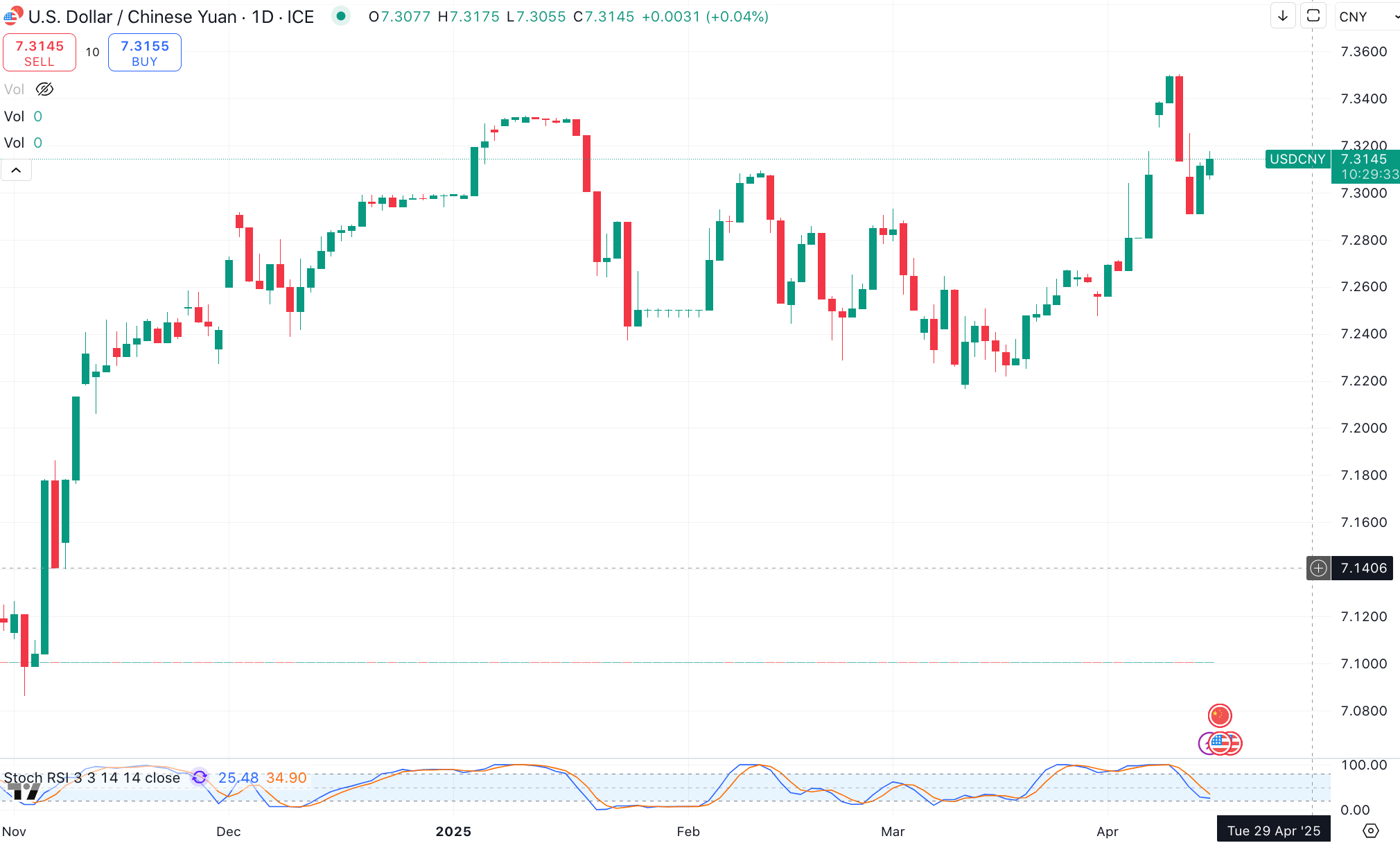
That’s not a coincidence.
Here’s the theory: The Chinese government is propping up the yuan via its major state-owned banks. That means they’re selling U.S. dollars — and flooding the global system with USD liquidity.
And what happens when the market gets flooded with dollars?
➡️ Gold rises
➡️ Bitcoin climbs
➡️ And the SP500 may have just bottomed
This also tells us something deeper: Beijing and Washington are negotiating. And Xi Jinping, rather than risk further provocation, is holding the yuan stable, even at the cost of burning through dollar reserves.
Trump has hinted at ongoing talks in his tweets and pressers, and this currency behavior adds weight to that claim. So, watching the USD/CNY chart could give us a real-time pulse check on whether those negotiations are progressing or breaking down.
🕵️♂️ Is Trump Trading on Inside Info?
Let’s talk about the insider trading accusation.
Media outlets are openly speculating that Trump may be acting on non-public information to time his market comments. But this raises a broader question: How much of the financial system is already driven by illicit inside info?
TBH, it’s probably more than anyone admits.

The morning before Trump tweeted that it was a “great time to buy stocks,” JPMorgan’s CEO went on record predicting an imminent recession. Trump’s post came before the market session even began — not in reaction, but in anticipation.
That tweet helped fuel the 9.5% rally in the S&P500 the next day.
Whether that’s market manipulation or just strategic optimism is up for debate. But the sequence of events is clear: bearish recession talk, Trump’s bullish tweet, then a massive inflow into the market.
And speaking of inflows…
🧾 The SPY ETF: A Signal That Everyone’s Already Sold?
The SPY ETF, which mirrors the SP500, saw such enormous demand during the April 9 rally that dealers couldn’t keep up. Trading volume surged so fast that the ETF’s price temporarily traded at a premium to the value of the underlying stocks it represents.

That almost never happens.
This dislocation implies that so many investors rushed to buy SPY shares that the ETF market ran out of inventory — forcing dealers to scramble to hedge exposure and track the index.
Our take?
This may not be a sign that the market has bottomed...
It might just mean there’s nobody left to sell.
And in markets, when everyone’s already out, that’s when the upside gets explosive.
🧠 Earnings, Fear, and the Real Opportunity
All of this is happening right before earnings season.
Companies are about to issue guidance (projections on future performance) into a totally unpredictable macro environment.
So what should you expect?
➡️ Conservative estimates, vague forecasts, and lots of fear
That’s a gift.
Because our companies, for the most part, haven’t changed even if their stock prices have.
This is where millionaires are made.
📊 Indicators We Use to Stay Rational
Before we buy anything, I check the Fear & Greed Index. Right now, it’s flashing extreme fear —and has been for weeks. That’s the longest stretch of fear I've seen in years.

The index combines:
Market momentum (vs 125-day average)
Option put/call ratios
Market breadth
Volatility (VIX)
Safe haven demand (stocks vs bonds)
Let me highlight the two we use most:
Market Momentum
Measures how far the S&P is above or below its 6-month average. It spiked after Trump’s pause, then cratered the next day. Another fake-out.Volatility (VIX)
A forward-looking gauge of fear. Anything over 20 is high; over 40 is panic. We hit both this last week.
Bottom line… These indicators stop us from buying too early and/or too late. We’re not here to catch the bottom. We’re here to build wealth without FOMO.
Remember: Markets are made in moments like these
💼 The Hermit Portfolio (THP)
To build a portfolio that thrives in times of chaos, we focus on one core principle: becoming the top 1% most knowledgeable analysts of the companies we hold.
That means going beyond headlines and price action — we study business models, balance sheets, macro exposure, leadership decisions, and competitive dynamics with obsessive attention to detail.
When volatility strikes and the crowd reacts emotionally, we act from conviction.
We don’t guess.
We know what we own, why we own it, and what it’s truly worth.
This depth of understanding allows us to hold — or even increase — positions when others are forced to sell at irrational discounts.
That’s how long-term wealth is built: not by predicting short-term chaos, but by preparing for it through relentless research and discipline.
If you're curious to see this approach in action, here are the latest 3 editions, where you can check all our movements and progress:


Hello Alejandro,
I hope this communique finds you in a moment of stillness.
Have huge respect for your work.
We’ve just opened the first door of something we’ve been quietly crafting for years—
A work not meant for markets, but for reflection and memory.
Not designed to perform, but to endure.
It’s called The Silent Treasury.
A place where judgment is kept like firewood: dry, sacred, and meant for long winters.
Where trust, patience, and self-stewardship are treated as capital—more rare, perhaps, than liquidity itself.
This first piece speaks to a quiet truth we’ve long sat with:
Why many modern PE, VC, Hedge, Alt funds, SPAC, and rollups fracture before they truly root.
And what it means to build something meant to be left, not merely exited.
It’s not short. Or viral. But it’s built to last.
And if it speaks to something you’ve always known but rarely seen expressed,
then perhaps this work belongs in your world.
The publication link is enclosed, should you wish to open it.
https://helloin.substack.com/p/built-to-be-left?r=5i8pez
Warmly,
The Silent Treasury
A vault where wisdom echoes in stillness, and eternity breathes.